


In credit activities, bank debt transfer is a solution used by many credit institutions to restructure their loan portfolios, improve capital efficiency and support debt resolution in line with their risk management strategies. However, the value of a debt does not depend solely on the outstanding balance but is also affected by recoverability, the legal status of the loan and the value of collateral. Therefore, before conducting a transaction, the parties usually carry out a comprehensive assessment of the debt to establish a basis for negotiation and make appropriate decisions.

What is bank debt transfer?
Bank debt transfer is the process by which a bank or an organization holding the right to recover a loan transfers its right to demand payment to another party in accordance with an agreement and applicable laws. Once the transaction is completed, the transferee may exercise the rights associated with the debt within the scope of the transfer.
In practice, this activity commonly takes place between:
-
Commercial banks.
-
Finance companies.
-
Asset Management Companies of credit institutions (AMCs).
-
Vietnam Asset Management Company (VAMC).
-
Enterprises engaged in debt trading.
-
Investors that meet the conditions prescribed by law.
For example, a bank may be managing a loan secured by real estate but wish to recover capital earlier to restructure its credit portfolio. Instead of continuing to manage the loan, the bank may transfer the rights associated with the debt to another entity seeking investment opportunities or specializing in debt resolution.
When do banks conduct bank debt transfer?
Not every transferred debt is a non-performing loan. In practice, bank debt transfer is a financial management tool used by many credit institutions to optimize operational efficiency and manage risks.
Restructuring the credit portfolio
A banks loan portfolio is continuously adjusted over time to align with its business strategy, risk limits and development priorities across different sectors.
Transferring certain debts can help banks:
-
Adjust the structure of outstanding loans by industry or customer group.
-
Increase the ability to allocate capital to priority sectors.
-
Reduce the management burden associated with loans that no longer align with the banks business strategy.
This is a credit portfolio management activity used by many banks and is not limited to situations involving non-performing loans.
Recovering capital and improving capital efficiency
For loans with extended recovery periods, banks may consider transferring the debt to recover part of their capital for business operations or credit expansion.
Compared with continuing to monitor and manage a loan over a long period, bank debt transfer may help credit institutions improve cash flow and optimize capital efficiency.
However, the decision to transfer a debt is always considered based on multiple factors such as recoverability, collateral value and the outlook of the loan.
Transferring debt to specialized debt resolution entities
Some loans involve complex legal documentation or require substantial resources to resolve. In such cases, banks may transfer the debt to enterprises specializing in debt management and resolution.
These entities often have experience working with customers, handling collateral or developing recovery plans appropriate to each debt.
Such a transfer does not mean that the bank abandons its interests but rather represents the selection of a more effective management solution for a particular loan.
.jpg)
Factors determining the bank debt transfer price
A common assumption is that the transfer price of a debt is equal to the outstanding principal balance or the value of the collateral. In practice, the law does not prescribe a specific formula for determining the transfer price. The transaction price is agreed upon by the parties based on a comprehensive assessment of multiple factors.
Debt recoverability
This is one of the factors with the greatest impact on the value of a debt.
The transferee generally considers:
-
The customers payment history.
-
Overdue status.
-
The borrowers financial capacity.
-
The ability to continue fulfilling repayment obligations.
-
Future recovery prospects.
A debt with a high probability of recovery generally has a higher transfer value than a debt that has remained unresolved for many years or has encountered difficulties during the recovery process.
Collateral value
For secured loans, the market value of collateral is one of the important factors used to assess the level of security associated with the debt.
However, a clear distinction should be made between collateral value and the bank debt transfer price.
For example, if a loan has an outstanding balance of VND 60 billion and the collateral is valued at approximately VND 75 billion, this does not mean that the transfer price will be VND 75 billion. Conversely, if the collateral decreases in value because of market fluctuations or deterioration, the transaction price is not automatically equal to the remaining value of the asset.
In practice, collateral value is only one of several factors considered by the parties during negotiations.
Legal status of the debt and collateral
A debt supported by complete legal documentation generally facilitates a smoother transfer process.
Relevant considerations include:
-
Credit agreement.
-
Security agreement.
-
Asset ownership documents.
-
Status of security interest registration.
-
Ability to dispose of the asset in accordance with applicable laws.
If the asset is subject to a dispute or its documentation is incomplete, the cost and time required for resolution may increase, thereby affecting the transferees investment decision.
Liquidity and resolution costs
A high-value asset that is difficult to transfer may not necessarily provide efficient capital recovery.
For example, a specialized factory or production line may take considerably longer to find a buyer than residential real estate located in an area with an active transaction market.
In addition, costs such as legal expenses, asset management, maintenance or dispute resolution are also considered when determining the transaction price.
Role of appraisal in bank debt transfer
In bank debt transfer transactions, the value of collateral is one of the important factors used to assess the level of security associated with the debt and the potential for capital recovery. However, a clear distinction should be made between debt valuation and collateral appraisal.
A debt represents the right to demand payment arising from a credit agreement while collateral is the asset used to secure the repayment obligation. The debt transfer price is agreed upon by the parties based on various factors such as recoverability, legal status, collateral value, resolution costs and market conditions.
Therefore, in practice, an appraisal company does not determine the purchase or sale price of the debt. Instead, it provides collateral appraisal results to give the parties an additional objective basis for evaluating and negotiating the transaction.
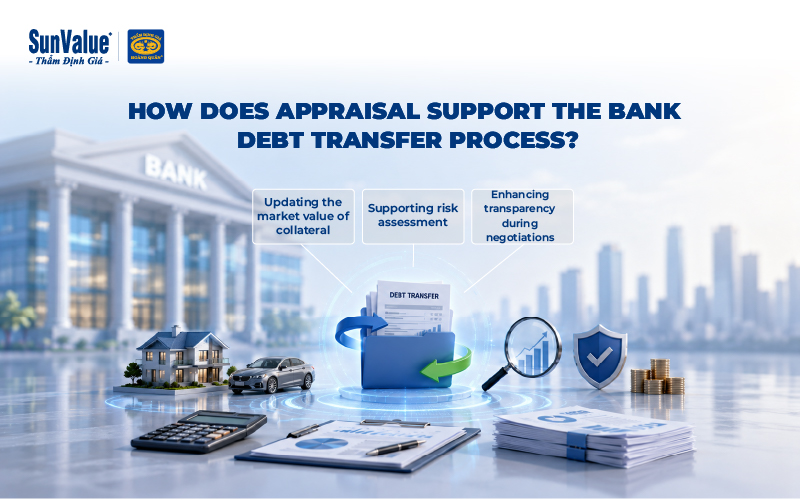
How does appraisal support the bank debt transfer process?
For debts secured by collateral, updating the value of the asset at the time of the transaction can provide various benefits to both the transferor and the transferee.
Updating the market value of collateral
The value of an asset at the time the credit facility was granted may no longer reflect market conditions several years later.
For example:
-
Real estate may increase or decrease in value due to planning, infrastructure development or market fluctuations.
-
Machinery and equipment may decrease in value due to wear and tear or technological changes.
-
Investment projects may experience changes in progress or utilization potential.
-
Factories may deteriorate after extended periods of use.
Reappraisal helps reflect market value at the time of transfer, thereby supporting a more accurate assessment of potential capital recovery.
Supporting risk assessment
Not every high-value asset can be easily disposed of when a debt needs to be resolved.
Through inspection and analysis, an appraisal company can provide additional information regarding:
-
The current condition of the asset.
-
Liquidity.
-
Utilization or transfer potential.
-
Factors that may affect future value.
This provides a basis for the transferee to assess risks before deciding whether to proceed with the transaction.
Enhancing transparency during negotiations
In many cases, the parties may have different views regarding the value of collateral. An appraisal report prepared by an independent appraisal company provides an additional objective source of information for reference during negotiations.
It should be noted that a valuation certificate does not determine the bank debt transfer price. The final transaction price remains subject to agreement between the parties based on a comprehensive assessment of multiple factors.
Asset appraisal process for bank debt transfer
When a bank or enterprise needs to update the value of collateral, the appraisal company generally follows the steps below:
Step 1. Receiving documents
The appraiser receives and reviews relevant documents such as:
-
Legal documentation of the asset.
-
Security agreement.
-
Technical documentation.
-
Documents proving ownership or rights to use the asset.
The initial review helps determine the scope of work and identify any additional information required.
Step 2. Conducting an on-site inspection
Depending on the type of asset, the appraiser conducts an inspection to:
-
Examine the current condition.
-
Compare the asset with its legal documentation.
-
Record its current use and condition.
-
Collect information on factors affecting its value.
For real estate, the inspection also considers location, infrastructure, planning and market transaction conditions.
Step 3. Analyzing data and determining value
After collecting the necessary information, the appraisal company analyzes market data, selects appropriate methods and determines the value of the asset in accordance with the 2023 Law on Prices and the Vietnam Valuation Standards.
Step 4. Issuing the appraisal report and valuation certificate
The final result is presented in an appraisal report and valuation certificate. These documents reflect the professional opinion regarding the value of the asset at the valuation date and may be used by the parties as a reference when assessing the transaction.
When should appraisal services be considered for bank debt transfer?
Although the law does not require appraisal for every bank debt transfer transaction, the service is often considered in the following circumstances:
-
The debt has a significant value or involves multiple parties.
-
The collateral consists of real estate, investment projects, factories or high-value machinery and equipment.
-
The asset value was determined several years ago and needs to be updated according to current market conditions.
-
The market has experienced significant price fluctuations or planning changes that may affect asset value.
-
Banks, enterprises or investors need an additional objective basis for assessing risks and negotiating the transfer price.
For smaller debts or those secured by relatively straightforward assets, the parties may choose other assessment methods depending on their needs and internal regulations.
With more than 24 years of experience in appraisal, Hoang Quan Appraisal provides appraisal services for various types of collateral including real estate, investment projects, factories, industrial facilities, machinery and equipment, enterprises, capital contributions and property rights as prescribed by law.
The appraisal process is conducted by qualified appraisers and combines on-site inspections, market data collection and valuation methods appropriate to each type of asset. The appraisal results help clients update collateral values at the time of the transaction, support risk analysis, enhance transparency and provide an additional reference basis during the bank debt transfer process.

Frequently asked questions
-
Is appraisal mandatory for bank debt transfer?
No. Current laws do not require every debt transfer transaction to have a valuation certificate. The use of appraisal services depends on the needs of the parties and the characteristics of each transaction.
-
How is the bank debt transfer price determined?
The transfer price is agreed upon by the parties based on multiple factors such as debt recoverability, collateral value, legal status, resolution costs and market conditions.
-
Is the value stated in a valuation certificate the purchase or sale price of the debt?
No. A valuation certificate reflects the value of the collateral at the valuation date. It is one of the sources of information that the parties may use when assessing the transaction and is not a mandatory price for the bank debt transfer.
Conclusion
Bank debt transfer is a solution used by many credit institutions to restructure their credit portfolios, improve capital efficiency and support debt resolution. The value of a debt is determined based on a combination of multiple factors of which collateral value is only one part of the overall assessment.
For high-value transactions or those involving complex collateral, appraisal helps update the market value of the asset, supports risk assessment and provides an additional objective basis for negotiations. Selecting an appraisal company with appropriate capabilities and experience can contribute to greater transparency and efficiency in bank debt transfer transactions.


