


A bank mortgage loan is a financial solution commonly chosen by individuals and businesses when they need substantial funding with a long repayment term and interest rates that are generally lower than those of unsecured loans. However, for a loan to be approved smoothly, borrowers must not only meet the bank’s requirements but also prepare complete documentation and accurately determine the value of the collateral. This article will help you understand the bank mortgage loan process, the necessary requirements and the role of asset appraisal before applying for financing.

What is a bank mortgage loan?
A bank mortgage loan is a form of credit in which the borrower uses an asset legally owned by themselves or by a third party, provided that the applicable requirements are met, as security for the repayment obligation. During the loan term, the borrower may continue to use the asset in accordance with the agreement but the asset will serve as collateral for the loan.
This type of loan is commonly used for purposes such as:
-
Purchasing a house or apartment.
-
Purchasing land.
-
Building or renovating a house.
-
Supplementing business capital.
-
Investing in projects.
-
Purchasing machinery and equipment.
-
Expanding production.
-
Restructuring capital sources.
Compared with unsecured loans, a bank mortgage loan generally offers advantages such as:
-
Higher loan limits.
-
Longer loan terms.
-
Generally lower interest rates.
-
Suitability for high-value financing needs.
However, whether a bank approves the loan depends on various factors such as repayment capacity, the legal status of the asset, credit history and the valuation result of the collateral.
Comparison between mortgage loans and unsecured loans
|
Criteria |
Mortgage loan |
Unsecured loan |
|
Collateral |
Required |
Not required |
|
Loan limit |
Higher |
Lower |
|
Loan term |
May be up to 25–30 years |
Usually shorter |
|
Interest rate |
Generally lower |
Generally higher |
|
Approval requirements |
Depend on the asset and repayment capacity |
Mainly based on income and credit history |
|
Suitable for |
Home purchase, investment and business |
Consumption and short-term expenses |
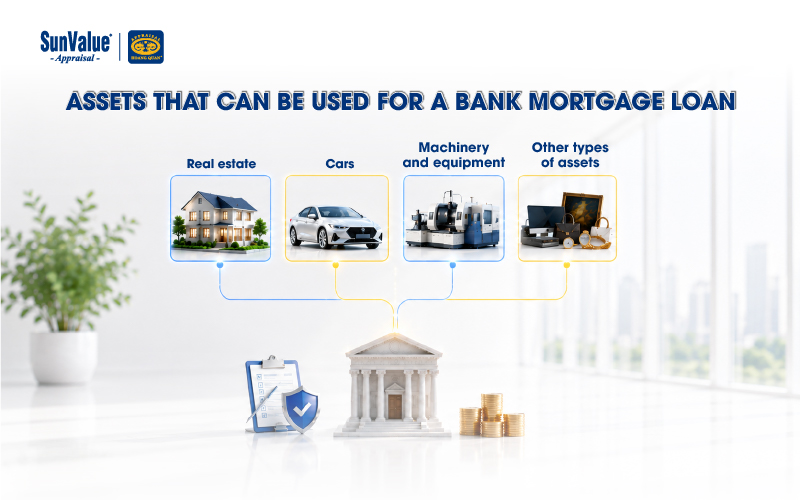
Assets that can be used for a bank mortgage loan
Not every asset is accepted by banks as collateral. In practice, each credit institution has its own requirements regarding asset types, legal documentation and valuation standards.
Assets commonly used for a bank mortgage loan include:
Real estate
This is the most commonly used type of collateral and may include:
-
Land use rights.
-
Detached houses.
-
Apartments.
-
Factories.
-
Warehouses.
-
Commercial and service land.
-
Certain real estate projects that meet legal requirements.
For real estate, banks generally review the legal status, planning information, transferability and market value carefully before determining the loan limit.
Cars
Personal vehicles or vehicles used for business purposes may be used as collateral if they meet requirements regarding ownership, condition and residual value.
Machinery and equipment
For businesses, many banks accept machinery, production lines or specialized equipment as collateral. The value of these assets is generally determined through a professional appraisal process.
Other types of assets
Depending on each bank’s policies, certain other assets may also be considered, such as:
-
Means of transportation.
-
Inventories and circulating goods.
-
Property rights.
-
Future assets, provided they meet applicable legal requirements and the bank’s policies.
Bank mortgage loan requirements
Each bank has its own lending policies and credit requirements. However, borrowers generally need to meet several basic conditions:
-
Have full civil legal capacity and civil act capacity in accordance with applicable law.
-
Have a lawful and clearly defined borrowing purpose that complies with the bank’s requirements.
-
Demonstrate repayment capacity through income, business activities or other lawful financial sources.
-
Have collateral under lawful ownership or lawful use rights that is eligible for mortgage in accordance with applicable regulations.
-
Prepare complete documentation including identification documents, proof of income, documents supporting the borrowing purpose and legal documents relating to the collateral.
In addition to these conditions, banks assess the overall application before making a lending decision. Important factors commonly considered include the customer’s credit history through the Credit Information Center (CIC), total outstanding debt, the value and legal status of the collateral, the loan-to-value ratio (LTV), the stability of income sources and the feasibility of the proposed use of funds.
Meeting all of these requirements does not guarantee loan approval because the final decision also depends on the appraisal process and the credit policies of each bank at the time the application is reviewed.
Bank mortgage loan documentation
To facilitate the appraisal and loan approval process, borrowers should prepare all documents required by the bank. A typical application includes four main groups:
-
Personal documents: Citizen Identification Card or passport, if applicable, together with residence documents required by each bank.
-
Proof of income: Salary statements, employment contracts, business records, financial statements or other documents proving lawful income depending on the type of borrower.
-
Documents proving the borrowing purpose: Purchase agreements, construction cost estimates, business plans or other documents related to the intended use of funds.
-
Collateral documents: Certificates of Land Use Rights, house ownership documents or other documents proving lawful ownership of the mortgaged asset.
In addition to these documents, the bank may request supplementary information to verify the legal status of the asset, income sources or other matters required for the loan assessment process.
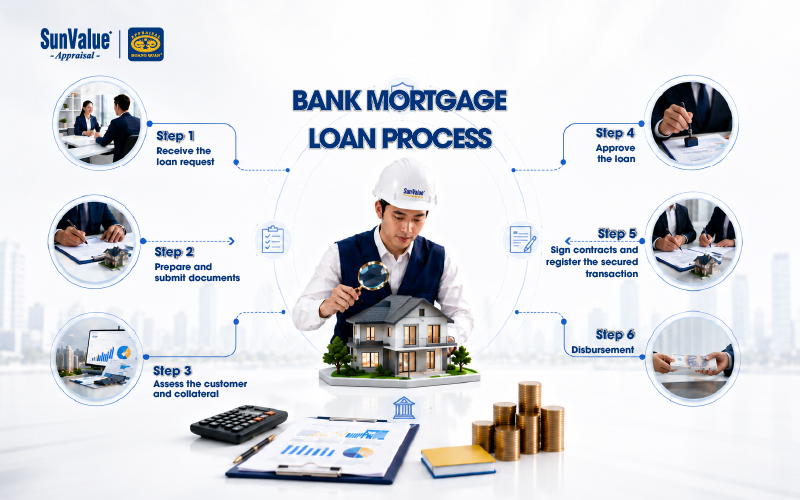
Bank mortgage loan process
The bank mortgage loan process at most banks generally includes the following steps:
-
Step 1 - Receive the loan request: The customer discusses the borrowing purpose, required loan amount and proposed collateral.
-
Step 2 - Prepare and submit documents: The bank checks whether the application is complete and provides instructions for additional documents if necessary.
-
Step 3 - Assess the customer and collateral: This is an important step intended to evaluate:
-
Repayment capacity.
-
Legal status of the asset.
-
Market value of the asset.
-
Risk level of the loan.
-
-
Step 4 - Approve the loan: After completing the assessment, the bank determines the loan limit, loan term, interest rate and credit conditions.
-
Step 5 - Sign contracts and register the secured transaction: The parties sign the credit agreement and mortgage agreement then complete the required procedures.
-
Step 6 - Disbursement: The loan is disbursed in accordance with the terms agreed in the credit agreement.
Reference interest rates for bank mortgage loans
Interest rates for a bank mortgage loan are not fixed and depend on the bank, borrowing purpose, loan term, collateral value and the customer’s credit profile. Currently, many banks offer preferential interest rates of approximately 5.5% to 10% per year during the initial period of the loan. After the preferential period, the interest rate is generally adjusted based on the bank’s base rate or reference rate plus an agreed margin specified in the contract.
Some reference mortgage loan interest rates include:
-
Vietcombank: approximately 5.5–9.5% per year.
-
BIDV: approximately 5.5–9.5% per year.
-
VietinBank: approximately 6.0–9.5% per year.
-
Agribank: approximately 6.5–10.5% per year.
-
Techcombank: from 6.0% per year.
-
ACB: approximately 6.9–12% per year.
-
HDBank: approximately 6.6–10.6% per year.
-
VPBank: approximately 6.9–12.3% per year.
When selecting a loan, borrowers should not compare only the initial preferential interest rate. They should also consider the preferential period, the interest calculation method after that period, the adjustment margin, repayment method, early repayment fees and other related costs. These factors directly affect the total borrowing cost over the entire loan term.
How banks determine the bank mortgage loan limit
One of the questions many customers are concerned about is “How much can I borrow?” In practice, banks do not base their decision solely on asset value but assess multiple factors before determining the credit limit.
Factors commonly considered include:
-
Market value of the collateral.
-
Loan-to-value ratio (LTV).
-
Customer income and repayment capacity.
-
Credit history (CIC).
-
Purpose of the loan.
-
Credit policies of each bank at the time of borrowing.
Among these factors, the value of the collateral is an important basis for determining the loan limit. Banks generally lend a certain percentage of the appraised asset value rather than relying on the purchase price or the value estimated by the owner.
Illustrative example: Assume a house is valued at VND 5 billion and the bank applies a maximum loan-to-value ratio of 70%. The maximum indicative loan limit would therefore be VND 3.5 billion.
However, if the customer’s income does not meet the required level or their credit history is unsatisfactory, the actual loan limit may be lower than the amount calculated above.
Factors affecting the value of collateral
Not all assets are valued in the same way. The value of collateral may be affected by various factors such as:
-
Legal status: Banks generally prioritize assets with complete and clear legal documentation that are eligible for transactions under applicable regulations.
-
Location and liquidity: For real estate, location, infrastructure, planning information and transferability are important factors in determining value.
-
Asset condition: Construction quality, age, depreciation, utilization potential and current condition may all affect the valuation result.
-
Market fluctuations: Asset values may change according to market developments, supply and demand, economic policies and planning conditions at a particular time.
Why should assets be appraised before applying for a bank mortgage loan?
Many customers believe that waiting for the bank to conduct its own valuation is sufficient. However, in some cases, proactively obtaining an asset appraisal before working with the bank may provide several benefits.
-
Proactively determine asset value: The appraisal result gives the owner an additional reference for the market value of the asset before preparing a financing plan or negotiating with a partner.
-
Prepare documentation more effectively: Understanding the legal status and value of the asset helps customers proactively complete their documentation and reduce repeated requests for supplementary documents during the approval process.
-
Support financial planning: Knowing the indicative value of the asset allows customers to estimate an appropriate loan limit, balance their own capital and develop a feasible repayment plan.
-
Suitable for purposes beyond borrowing: An appraisal report may also serve as a reference for purchases, sales, transfers, capital contributions, asset disposal, corporate restructuring or other financial purposes in accordance with applicable regulations.
Important considerations before applying for a bank mortgage loan
To minimize risks and improve the possibility of loan approval, borrowers should consider the following:
-
Clearly determine the borrowing need and repayment capacity.
-
Carefully review preferential interest rates and post-preferential rates.
-
Read the terms relating to early repayment fees and other costs carefully.
-
Check the legal status of the asset before mortgaging it.
-
Prepare all documents required by the bank.
-
Avoid borrowing beyond the financial capacity of the individual or business.
-
Proactively obtain a reference value for the asset before developing a financing plan.
Asset appraisal services for bank mortgage loans at Hoang Quan Appraisal
.jpg)
For high-value loans, particularly those used to purchase a house, invest in real estate, expand production and business operations or supplement corporate capital, accurately determining the value of the collateral is an important step in preparing the loan application.
Hoang Quan Appraisal provides appraisal services for various types of assets including real estate, factories, machinery and equipment, means of transportation, enterprises, investment projects and other assets in accordance with applicable laws. Appraisal activities are conducted according to professional procedures using methods appropriate to each type of asset and appraisal purpose.
Appraisal reports and appraisal certificates provide customers with an additional reference for the market value of their assets when working with banks, credit institutions, business partners or competent authorities. At the same time, preparing complete asset information from the outset can help shorten application processing time and support the development of an appropriate financial plan.
Customers who require asset appraisal before applying for financing, purchasing or selling assets, making capital contributions, disposing of collateral or conducting other financial transactions may contact Hoang Quan Appraisal for consultation on required documentation, procedures and implementation timelines for each type of asset.
Hoang Quan Appraisal Company Limited
Address: Hoang Quan Appraisal System
Phone: 0934.252.707
Email: contact@sunvalue.vn
Facebook: Hoang Quan Appraisal
Website: hqa.com.vn
Conclusion
A bank mortgage loan is a suitable financial solution when substantial funding with a long repayment term is required. To improve the likelihood of approval, borrowers should prepare complete documentation, properly assess their financial capacity and accurately determine the value of the collateral. When an objective basis for asset value is needed before working with a bank, an independent appraisal service can support a more effective and transparent loan preparation process.


