


Company valuation is the process of determining the true value of a business at a specific point in time based on its assets, revenue, profits, cash flow and market position. Valuation results are used for M&A, fundraising, bank financing and share transfers.
In practice, many businesses may be valued 20–40% below their actual value, resulting in reduced negotiating power or financial losses worth billions of Vietnamese dong.

What is company valuation?
Company valuation is the process of determining the true value of a business at a specific point in time based on various financial and non-financial factors, including:
-
Tangible assets such as factories, machinery and real estate
-
Intangible assets such as brands, customer relationships and data
-
Revenue and profits
-
Future cash flows
-
Competitive position in the market
Unlike subjective estimates, professional company valuation must be based on:
-
Accurate financial data
-
Scientific calculation methods
-
Practical market experience
-
A clear legal basis
A valuation result is not merely a number. It is an important financial decision-making tool.
In practice, many businesses may be undervalued by 20–40% because they do not apply appropriate valuation methods.
When is company valuation required?
Many businesses only conduct a valuation when preparing to sell. However, company valuation is necessary for most major financial decisions.
Mergers and acquisitions (M&A)
-
Avoid being pressured into accepting a low price
-
Determine a reasonable transaction price
-
Strengthen negotiating power
Fundraising and investor attraction
-
Optimize the percentage of equity offered
-
Improve credibility
-
Attract investment funds
Bank financing
-
Provide a basis for demonstrating financial capacity
-
Support the bank’s assessment and approval process
Share transfers
-
Prevent disputes
-
Ensure transparency
Financial reporting and auditing
-
Record asset values
-
Comply with accounting standards
-
Support auditing procedures
When a business is preparing for a major financial decision, company valuation is often necessary.

How is company valuation conducted?
To understand how company valuation works, it can be illustrated as follows:
Business value = Current assets + Future income-generating capacity + Market value
Based on this concept, there are three main valuation approaches:
(1) Asset-based valuation
This approach calculates the total value of the assets currently owned by the business.
➡ Suitable for:
-
Companies with significant fixed assets
-
Manufacturing and real estate businesses
(2) Profit- and cash flow-based valuation
This approach evaluates how much income the business currently generates and how much it is expected to generate in the future.
➡ Suitable for:
-
Businesses with stable operations
-
Businesses with identifiable and consistent cash flows
(3) Market-based valuation
This approach compares the business with similar companies that have been involved in market transactions.
➡ Suitable for:
-
Industries with sufficient market data
-
Common and established business sectors
In practice, professional valuation companies often combine all three approaches to improve the accuracy and reliability of company valuation results.
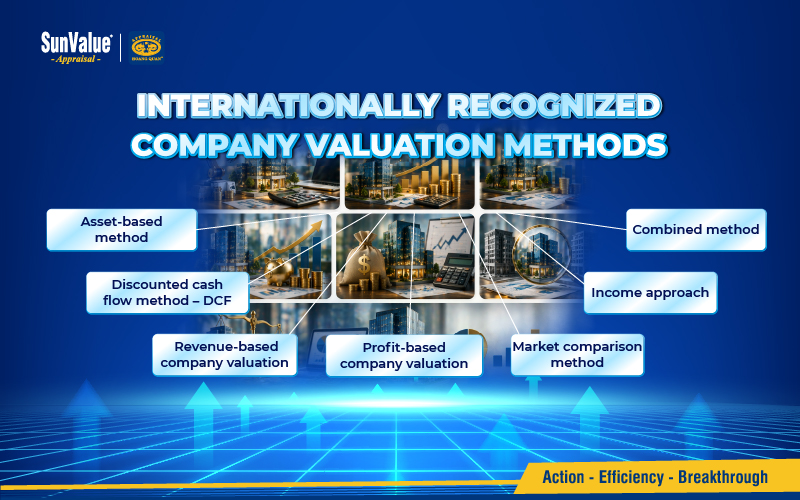
Seven internationally recognized company valuation methods
1. Asset-based method
Formula: Value = Total assets – Total liabilities
This method reflects the current net asset value of a business. It is relatively easy to understand and less dependent on forecasts, but it may not fully reflect the company’s future growth potential.
The asset-based method is suitable for:
-
Manufacturing companies
-
Asset-intensive businesses
2. Discounted cash flow (DCF) method
The DCF method is one of the most important methods used in company valuation.
The principle is that money received in the future is worth less than money received today. Future cash flows must therefore be discounted to their present value.
For example, a company expected to generate VND 10 billion annually for five years is not automatically worth VND 50 billion. Its present value will be lower because of the time value of money and associated risks.
This method can effectively reflect future potential and is commonly used by investors, but its reliability depends heavily on the accuracy of financial forecasts.
The DCF method is commonly used by:
-
Investment funds
-
Large corporations
3. Revenue-based company valuation
Formula: Value = Revenue × Industry multiple
This method is suitable for:
-
Startups
-
Fast-growing companies
4. Profit-based company valuation
Formula: Value = Profit × P/E ratio
This is one of the most commonly used methods in the stock market. The amount of profit generated by a business is used as an important basis for determining its value.
5. Market comparison method
This method compares the business with similar companies based on factors such as:
-
Business size
-
Industry
It is one of the methods that most closely reflects the actual market value of a business.
6. Income approach
This approach determines value based on the company’s long-term income-generating capacity.
7. Combined method (professional approach)
This method is commonly applied by professional valuation companies.
It involves:
-
Combining multiple valuation methods
-
Reducing potential discrepancies
-
Improving the reliability of the final valuation result
Company valuation for different situations
How to value a joint-stock company
The company’s value is determined and then divided by the total number of shares.
Formula: Value per share = Total company value ÷ Total number of shares
How to value a company for fundraising
The valuation process focuses on:
-
Growth
-
Future cash flows
-
Market potential
Investors are not only investing in the current business. They are investing in its future potential.
How to conduct company valuation effectively for fundraising
To support a higher valuation, a business should:
-
Standardize its financial information
-
Increase revenue growth
-
Establish a clear business strategy
Company valuation is not only a calculation. It is also a financial strategy.
Factors that directly affect business value
A company’s value is not determined solely by its revenue or profits. The following factors can significantly affect company valuation:
-
Actual cash flow
-
Growth rate
-
Brand value and intangible assets
-
Competitive position
-
Industry risks
Two businesses generating the same level of profit may have completely different values.
Practical case study
A manufacturing company in Ho Chi Minh City estimated its own value at approximately VND 120 billion while preparing for a fundraising transaction.
After conducting an in-depth company valuation:
-
The DCF method was applied
-
Market comparisons with businesses in the same industry were conducted
-
The company’s determined value was VND 165 billion
Result: The business increased the transaction value by 37% and gained a stronger position in negotiations with investors.
Why should businesses not conduct their own company valuation?

Many businesses only recognize their valuation mistakes after entering negotiations and being pressured into accepting a lower price.
A business may be estimating its value based on:
-
Increasing revenue
-
Relatively stable profits
-
General perceptions of the market
However, these factors alone do not constitute a professional company valuation. They are only estimates without sufficient supporting evidence.
The greatest risk is not a minor miscalculation. It is a potential discrepancy worth tens of billions of Vietnamese dong.
A difference from actual value can cause a business to be sold too cheaply
A lack of market data and appropriate valuation methods may cause a company to be valued 20–40% below its actual value.
The business may therefore lose part of the value that its owners have spent years building.
Complete loss of negotiating power
Without a professional valuation report, the other party may enter negotiations with its own supporting figures while the business has no independent evidence.
This can result in the business being pressured into accepting an unfavorable price and losing control of the negotiation process.
Lack of recognition from banks and investors
A self-calculated figure without sufficient legal or professional support may not be accepted by banks. It may also cause investors to question the transparency and reliability of the business’s information.
Incorrect valuation leads to an ineffective financial strategy
-
An undervalued business may have to give up a larger percentage of equity.
-
An overvalued business may fail to attract investors.
The greatest risk is that the business may not recognize the mistake until an opportunity has already been lost.
Professional company valuation process at Hoang Quan Appraisal
To ensure accuracy, legal compliance and practical acceptance, company valuation must be conducted through a systematic professional process rather than through subjective or simplified estimates.
Step 1: Receive information and identify the valuation purpose
-
Determine whether the valuation is intended for fundraising, M&A, bank financing or share transfers
-
Collect the company’s legal, financial and operational documents
This step determines the appropriate valuation approach and methods.
Step 2: Conduct an in-depth financial analysis
-
Financial statements from the previous three to five years
-
Actual cash flows
-
Business operating performance
The purpose is not only to review the figures but also to understand the underlying nature and performance of the business.
Step 3: Research and assess the market
-
Compare the company with other businesses in the same industry
-
Analyze its competitive position
-
Assess industry trends and risks
This step helps ensure that the valuation result is not significantly different from the company’s actual market position.
Step 4: Apply appropriate valuation methods
-
Select suitable methods such as DCF, asset-based valuation or market comparison
-
Combine multiple methods to improve accuracy
-
Perform detailed calculations and control potential discrepancies
This is the stage where the final value is calculated. However, the result must be supported by reliable and appropriate data.
Step 5: Prepare the valuation report and complete legal documentation
-
Prepare a complete, transparent and evidence-based report
-
Comply with the Vietnam Valuation Standards and relevant international standards
-
Provide a report that can be used in actual transactions
The valuation report may be used for:
-
Banks, including financing and collateral purposes
-
Investors, including fundraising and M&A
-
Auditing and legal authorities
Why choose Hoang Quan Appraisal for your company valuation?
You may own a business worth tens or even hundreds of billions of Vietnamese dong. However, one incorrect valuation can result in the loss of negotiating power, a failed transaction or a missed opportunity.
In practice, many companies estimate their value based only on profits, revenue or general market perceptions. Although this may appear reasonable, it can become a costly mistake.
Such estimates often overlook intangible assets, lack reliable market comparisons and may not be accepted by relevant stakeholders. As a result, businesses may be pressured into accepting a lower value without fully recognizing the financial loss.
This is why businesses may require an independent professional valuation provider. Hoang Quan Appraisal supports clients in determining an appropriate company value from the beginning of the transaction process.
What makes Hoang Quan Appraisal different?
-
Valuers licensed by the Ministry of Finance
-
Practical experience from tens of thousands of valuation assignments nationwide
-
Simultaneous application of:
-
Vietnam Valuation Standards
-
International Valuation Standards – IVS
-
-
Valuation results supported by professional and legal foundations and suitable for consideration in practical transactions
Benefits of professional company valuation
-
Strengthen negotiating power
-
Reduce financial and legal risks
-
Improve credibility with banks and investors from the beginning
Many businesses may be valued below their actual value. Is your company one of them?
Within approximately 3-5 days, subject to the scale and complexity of the assignment, your business may receive a professionally prepared valuation report for use in M&A, bank financing or fundraising.
-
Register now: https://hqa.com.vn/
-
Hotline: 0934 252 707
-
Email: contact@sunvalue.vn
You will receive a complimentary one-on-one consultation with a specialist during business days.
-
An incorrect figure may cause you to lose an entire transaction.
-
An appropriate figure may help you strengthen your position at the negotiating table.
Contact Hoang Quan Appraisal before entering into an important transaction involving your business.
Frequently asked questions about company valuation
-
How long does company valuation take?
The process normally takes approximately three to seven days, depending on the scale and complexity of the business.
-
How much does company valuation cost?
The fee depends on the type, scale and complexity of the business.
-
Does the valuation report have legal validity?
Yes, provided that it is prepared by an eligible valuation enterprise in accordance with applicable regulations.


