Equitization is an important transformation process that helps enterprises reform their ownership structure, strengthen corporate governance and attract additional investment capital. However, for this process to be transparent, effective and risk-controlled, accurately determining the value of the enterprise, its assets, land use rights, brand and equity interests is essential. This is also where appraisal plays a particularly important role.

What is equitization?
Equitization is the process of converting an enterprise from a single-owner structure, typically an enterprise wholly owned by the State, into a joint-stock company in which multiple shareholders contribute capital, participate in governance and receive benefits in proportion to their ownership interests.
Simply put, equitization helps an enterprise transition from a concentrated ownership structure to a more flexible ownership model. By selling shares to investors, employees or relevant organizations, the enterprise can raise additional capital, reform its governance, improve operational efficiency and establish a foundation for development under market mechanisms.
In the context of restructuring state capital in enterprises, equitization is not merely a procedure for changing the legal form of an enterprise. It also involves a comprehensive reassessment of the enterprise’s value, assets, land use rights, liabilities, brand, business capabilities and future development potential.
According to information from the Government Electronic Information Portal, Decree No. 126/2017/ND-CP provided guidance on the process of converting state-owned enterprises into joint-stock companies, including the development of an equitization plan, implementation of the approved plan and completion of the conversion into a joint-stock company.
Why do enterprises need equitization?
Equitization is one of the important solutions that can help enterprises transform their governance model, mobilize resources from society and improve capital efficiency.
For state-owned enterprises, equitization may provide various benefits, including:
-
Increasing transparency in governance and finance.
-
Raising additional capital from external investors.
-
Creating incentives to reform management and operations.
-
Improving the efficiency of asset, capital and resource utilization.
-
Aligning the responsibilities of shareholders, managers and employees with business performance.
-
Creating a foundation for future listing, IPO, M&A or corporate restructuring.
In particular, when an enterprise owns substantial assets, including real estate, machinery and equipment, construction works, brands or distinctive business advantages, accurately determining the enterprise’s value before equitization is particularly important. If the value is determined too low, the State or the owner may suffer a loss of assets. If the value is set too high, the share sale process may become more difficult and less attractive to investors.
What is the equitization of state-owned enterprises?
The equitization of state-owned enterprises is the process of converting an enterprise wholly owned by the State or another enterprise subject to conversion under applicable regulations, into a joint-stock company.
After equitization, the enterprise operates as a joint-stock company with charter capital divided into shares. The State may continue to hold a certain percentage of shares or divest its ownership depending on the industry, the role of the enterprise and the plan approved by the competent authority.
In 2026, the Government issued Decree No. 57/2026/ND-CP on the restructuring of state capital in enterprises, effective from February 13, 2026. This regulation demonstrates that the restructuring of state capital, including matters relating to state-invested enterprises, continues to be subject to close regulatory oversight during the current period.
Enterprise equitization process
Depending on the type of enterprise, capital size, business sector and regulations applicable at a particular time, the equitization process may involve various steps. In general, however, the process typically consists of three main groups of activities.
1. Developing an equitization plan
This is the foundational stage of the entire equitization process. The enterprise needs to prepare legal documentation, asset records, capital information, liabilities, financial statements, land use plans, workforce plans and select appropriate methods for determining enterprise value.
According to guidance on the equitization process for state-owned enterprises, the development stage includes establishing a Steering Committee and supporting team, preparing documents, conducting asset inventories, handling financial matters, organizing the determination of enterprise value and disclosing the enterprise value.
This is also the stage where appraisal plays a particularly important role. Appraisal results provide a basis for determining the actual value of the enterprise, the value of state capital, the starting price for the sale of shares and the financial plan for the conversion.
2. Implementing the equitization plan
After the equitization plan has been approved, the enterprise proceeds with the sale of shares in accordance with the approved plan. Eligible purchasers may include strategic investors, external investors, employees of the enterprise and other organizations as prescribed by regulations.
At this stage, determining enterprise value in a transparent, well-supported manner consistent with market conditions can help strengthen investor confidence. A clear and objective appraisal report can help minimize disputes, reduce legal risks and facilitate a more efficient share offering process.
3. Completing the conversion into a joint-stock company
After completing the share sale, the enterprise organizes its first General Meeting of Shareholders, completes enterprise registration, finalizes accounts and conducts the handover between the former enterprise and the newly established joint-stock company.
This step formally establishes the new operating model. From this point onward, the enterprise operates under the joint-stock company structure and is governed by laws on enterprises, securities, finance, accounting and other relevant regulations.
Why is appraisal important in equitization?
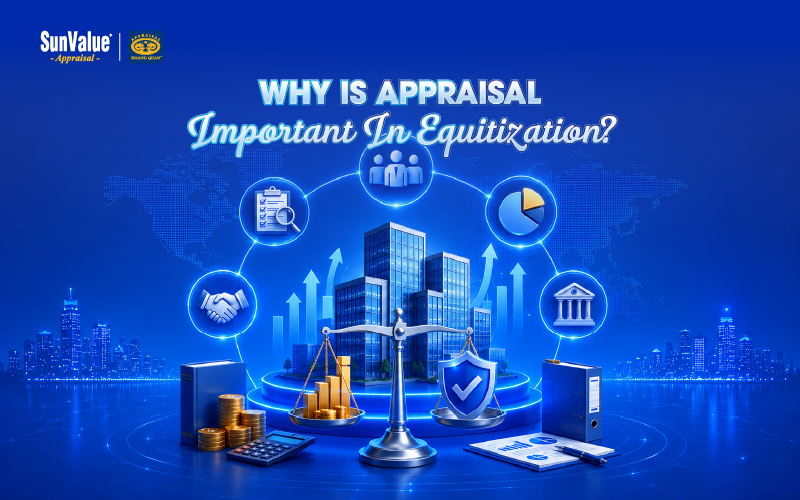
Equitization is always associated with a fundamental question: how much is the enterprise worth?
The answer cannot be based solely on accounting records. Enterprise value needs to be assessed from multiple perspectives, including tangible assets, intangible assets, cash flows, liabilities, land use rights, brand value, profit-generating capacity and business prospects.
Appraisal in the equitization process helps to:
-
Determine the actual value of the enterprise at the time of equitization.
-
Determine the value of state capital or owners’ equity.
-
Reassess assets based on market value.
-
Provide a basis for developing the share sale plan.
-
Minimize the risk of loss of capital and assets.
-
Increase transparency when working with investors.
-
Support financial planning, capital restructuring and post-equitization governance.
In practice, many enterprises have asset values that are significantly higher than or different from the figures recorded in their accounting books. This is particularly relevant for enterprises with substantial land holdings, factories, long-used machinery and equipment, established brands or complex financial investments.
Without independent and objective appraisal, the equitization process may involve various risks, including incorrect asset valuation, incomplete identification of financial obligations, inadequate recognition of business advantages or insufficient assessment of the future utilization potential of assets.
Assets that need to be appraised during equitization
When conducting equitization, enterprises generally need to review and appraise various categories of assets. Each asset category has its own valuation characteristics and requires appropriate methods and reliable market data.
Real estate and land use rights
This is one of the most valuable and sensitive asset categories in many equitization transactions. Enterprises need to clearly determine the legal status, land use purpose, land use term, planning status, conversion potential, market value and financial obligations associated with the land.
The land use plan prepared for equitization should be consistent with land use planning and plans, construction planning and the enterprise’s actual management and use of land at the time its value is determined.
Factories and construction works
Construction works attached to land, including factories, offices, warehouses, production facilities, shopping centers and technical infrastructure, should be assessed based on their actual condition, remaining quality, functionality and economic utilization potential.
Machinery, equipment and means of transportation
Machinery and equipment are common asset categories in manufacturing, logistics, construction, mechanical engineering, mining and industrial enterprises. Appraisal should consider the year of manufacture origin, capacity, degree of depreciation, operating condition, replacement cost and market liquidity.
Intangible assets and brands
Some enterprises possess valuable brands, trademarks, software, exploitation rights, intellectual property rights, customer data or business advantages. These assets can be difficult to value but may have a significant impact on the enterprise’s overall value.
Liabilities, financial obligations and investments
Before determining enterprise value, accounts receivable, accounts payable, borrowings, tax obligations, financial investments, capital contributions and contingent liabilities should be reviewed. Incomplete financial treatment may distort enterprise value and affect shareholders’ interests after equitization.
Methods for determining enterprise value during equitization
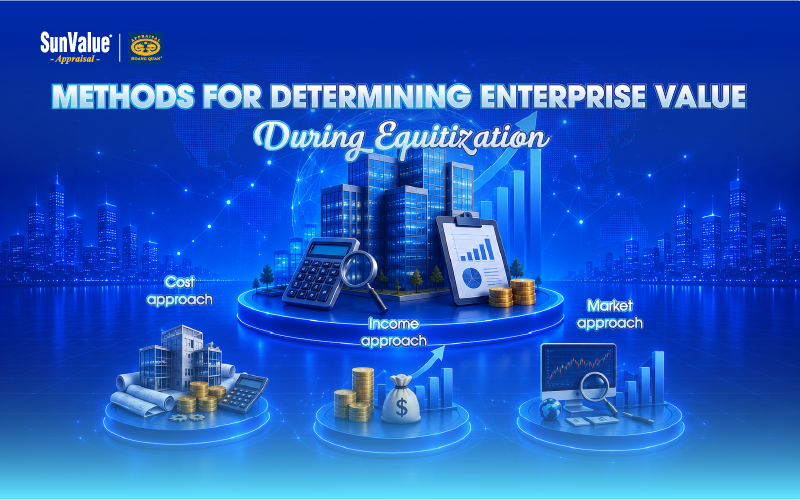
During equitization, enterprise value should be determined based on asset characteristics, business sector, cash flow generation capacity, market data and the purpose of the appraisal. In general, an appraisal firm may consider the following methods:
-
Cost approach: Determines enterprise value based on the value of existing assets after considering liabilities and relevant financial obligations. This approach is often suitable for enterprises with substantial real estate, land use rights, factories, machinery and equipment or other high-value tangible assets.
-
Income approach: Determines enterprise value based on the ability to generate future income, profits or cash flows. This approach is suitable for enterprises with stable business operations, identifiable cash flows, established brands, business advantages or growth potential.
-
Market approach: Determines enterprise value based on comparative data from similar enterprises, share transactions, equity transactions or financial indicators available in the market. This approach helps benchmark the enterprise’s value against prevailing market conditions.
In practice, determining enterprise value during equitization should not rely on a single method. Legal documentation, asset inspections, financial analysis, market data and professional judgment should be considered together to reflect enterprise value objectively and appropriately.
Risks of incorrectly determining the value of an enterprise undergoing equitization
Determining enterprise value is one of the stages most susceptible to risk during equitization. If the valuation result is inaccurate, the enterprise and relevant parties may face various consequences.
Common risks include:
-
Undervaluing assets, potentially resulting in capital losses.
-
Overvaluing assets, making shares more difficult to sell.
-
Failing to fully assess the value of land use rights.
-
Omitting intangible assets, brands or business advantages.
-
Failing to clearly address liabilities and financial obligations.
-
Disputes arising among shareholders, investors and regulatory authorities.
-
Delays in equitization, divestment or corporate restructuring.
In 2026, the Government continued to emphasize that the restructuring of state capital in enterprises must be conducted rigorously, publicly, transparently, efficiently and in accordance with the law, while preventing losses and waste of state capital and assets.
Hoang Quan Appraisal supports enterprises throughout the equitization process
For enterprises preparing for equitization, divestment, IPO, M&A or capital restructuring, selecting an independent and professional appraisal firm with strong market knowledge is important to ensure that documentation is well-supported, transparent and compliant with applicable regulations.
With experience in enterprise and asset appraisal, Hoang Quan Appraisal supports clients in determining enterprise value for equitization, equity transfers, mergers and acquisitions, investment, debt resolution, investment project appraisal and other financial purposes.
During the equitization process, we support enterprises in comprehensively assessing asset values, capital, business advantages and development potential, thereby providing an additional basis for developing an equitization plan that is transparent, objective and aligned with actual market conditions.
Services provided by Hoang Quan Appraisal include:
-
Enterprise value appraisal.
-
Appraisal of real estate, land use rights and assets attached to land.
-
Appraisal of machinery, equipment, production lines and means of transportation.
-
Appraisal of intangible assets, brands and business advantages.
-
Determination of the value of capital contributions, shares and owners’ equity.
-
Appraisal of investment projects and assets for equitization, divestment, M&A and IPO purposes.
-
Provision of valuation certificates and appraisal reports according to the client’s intended purpose.
With a diverse appraisal service system and an experienced professional team, Hoang Quan Appraisal places strong emphasis on independence, objectivity and transparency in every appraisal assignment. We understand that during equitization, each appraisal result is more than just a figure; it is also an important basis for helping enterprises preserve value, mitigate risks and build confidence among shareholders, investors and other stakeholders.
Hoang Quan Appraisal is committed to supporting enterprises with professional appraisal solutions tailored to specific purposes, contributing to an efficient and transparent equitization process aligned with their development objectives.
When should an enterprise conduct appraisal before equitization?
Enterprises should proactively conduct appraisal when:
-
Preparing to develop an equitization plan.
-
Needing to determine enterprise value at a specific point in time.
-
Holding significant assets that need to be reassessed at market value.
-
Holding real estate, land use rights or assets attached to land that require valuation.
-
Needing to determine the value of state capital or owners’ equity.
-
Preparing to sell shares to strategic investors.
-
Requiring documentation for an IPO, M&A or corporate restructuring.
-
Seeking to minimize legal and financial risks before changing the ownership structure.
The earlier an appraisal is conducted, the more time the enterprise has to review assets, address legal documentation, adjust its financial plan and prepare complete data before submitting the equitization plan to the competent authority for approval.
Frequently asked questions about equitization
-
Is equitization the same as privatization?
Equitization and privatization are similar in that both involve changes to an enterprise’s ownership structure. However, equitization is not necessarily the same as full privatization. Following equitization, the State may continue to hold an ownership interest in the enterprise depending on its industry, role and the approved plan.
-
Is appraisal mandatory for equitization?
In the enterprise conversion process, particularly for enterprises with state capital, determining enterprise value is an important step that provides a basis for developing the equitization plan, determining the value of capital interests and organizing the sale of shares. Engaging an independent appraisal firm can improve objectivity and transparency while reducing potential risks.
-
Which assets usually have significant value during equitization?
Assets that commonly represent significant value include land use rights, factories, construction works, machinery and equipment, means of transportation, financial investments, brands and business advantages.
-
What should an enterprise prepare for an equitization appraisal?
The enterprise should prepare legal documentation, financial statements, asset lists, land documentation, machinery and equipment records, liabilities, investments, land use plans and other documents relating to its business operations.
Conclusion
Equitization is an important transition that enables enterprises to change their ownership structure, improve governance efficiency, raise capital and strengthen competitiveness. However, for the equitization process to be transparent, compliant and appropriately risk-managed, enterprises should pay particular attention to determining enterprise value.
An objective appraisal result not only helps accurately reflect the value of assets, capital and business potential but also provides an important basis for developing an equitization plan, selling shares, attracting investors and protecting the interests of relevant stakeholders.
Hoang Quan Appraisal supports enterprises with the appraisal of businesses, real estate, movable assets, intangible assets, capital contributions and other assets for equitization, divestment, M&A, IPO and corporate restructuring purposes.
Contact Hoang Quan Appraisal today for professional and transparent appraisal solutions tailored to your enterprise’s equitization process.
Hoang Quan Appraisal Co., Ltd.
Address: Hoang Quan Appraisal System
Phone: 0934.252.707
Email: contact@sunvalue.vn
Facebook: Hoang Quan Appraisal
Website: hqa.com.vn