


A land dispute is a disagreement between individuals, households, organizations or other parties regarding rights and obligations related to land use rights or land-attached assets. Depending on the specific case, a dispute may be resolved through mediation, competent state authorities or the Court in accordance with applicable law.

Land dispute is one of the most common forms of civil dispute in Vietnam, arising from various causes such as handwritten transfer agreements, inheritance disputes, boundary determination, division of property upon divorce or disagreements over land use rights. In addition to affecting the rights and interests of the parties involved, these disputes may continue for years if legal documents are incomplete or the asset value cannot be determined objectively. This article provides updates on current regulations governing land dispute, dispute resolution procedures and the role of appraisal in supporting effective dispute resolution.
What is a land dispute?
Under current land laws, a land dispute is a disagreement between parties regarding rights, obligations or interests arising during the management and use of land.
Disputed matters may include:
-
Land use rights.
-
Boundaries between land parcels.
-
Ownership of land-attached assets.
-
Inheritance rights involving land use rights.
-
Contracts for the transfer, donation or capital contribution of land use rights.
Each type of dispute has different procedures, competent authorities and evidentiary requirements. Therefore, correctly identifying the nature of the dispute is the first step in selecting an appropriate resolution method.
Common types of land dispute
In practice, land dispute commonly occurs in the following forms:
|
Type of dispute |
Characteristics |
|
Boundary dispute |
Occurs when the parties disagree on boundary markers or the actual area being used. |
|
Land use rights dispute |
A disagreement over who legally holds the land use rights to a parcel of land. |
|
Inheritance dispute |
Arises when inherited assets such as land use rights or residential property are divided. |
|
Transfer contract dispute |
Relates to the purchase, sale, transfer or deposit agreement involving land. |
|
Property dispute upon divorce |
Involves determining the value of land use rights and jointly owned marital property. |
|
Shared access dispute |
Arises between neighboring households regarding the right to use a shared access path. |
Each type of dispute has its own characteristics and requires sufficient legal documents, evidence and in many cases professional determination of asset value.
For example, inheritance disputes often focus on identifying rightful heirs and determining the asset value for distribution while boundary disputes require cadastral records, current land survey results and documents showing the history of land use.
Why are land disputes becoming increasingly common?
Land is a high-value asset that is directly affected by planning, infrastructure and fluctuations in the real estate market. When land values increase rapidly, the risk of disputes may also increase.
Common causes include:
-
Transfer of land use rights through handwritten agreements or failure to register changes as required by law.
-
Inconsistencies in cadastral records from different periods, resulting in discrepancies in land area or boundaries.
-
Land without a Certificate of Land Use Rights or incomplete legal documentation.
-
Distribution of inherited property without a will or clear written agreement.
-
Changes in planning, road expansion or project implementation that give rise to disputes over compensation, support and resettlement.
-
Capital contribution using land use rights without clearly determining the value or the rights and obligations of the parties.
In addition to legal causes, a lack of information about the actual value of land use rights may also make it difficult for the parties to reach a common understanding during negotiations.

Land dispute resolution process under current regulations
Depending on the type of dispute, the resolution process may vary. However, it generally includes the following steps:
Step 1. Collect documents and evidence
The claimant should prepare relevant documents such as:
-
Certificate of Land Use Rights, if available.
-
Cadastral records.
-
Transfer, donation or capital contribution contracts.
-
Inheritance documents.
-
Maps and cadastral survey extracts.
-
Records confirming the current condition of the property.
-
Images, documents or other evidence demonstrating the history of land use.
Preparing complete documentation from the outset helps shorten the verification process and minimize disputes over evidence.
Step 2. Mediation
For certain types of land use rights disputes, the law requires mediation to be conducted in accordance with prescribed procedures before proceeding to the next stage of resolution. Successful mediation may help the parties save time and costs and preserve civil relationships.
Step 3. Request resolution by a competent authority
If mediation is unsuccessful or the matter falls within cases prescribed by law, the parties may request resolution by a competent state authority or file a lawsuit with the Court for consideration and resolution in accordance with applicable regulations.
Step 4. Collect and assess evidence
During the resolution process, the competent authority will review all records, evidence, documents, survey results, valuation results if available and other relevant factors before issuing a decision.
For disputes involving the division of property, compensation or determination of financial obligations, determining the value of land use rights at the time of resolution is often important for protecting the lawful rights and interests of the parties.
When is appraisal needed in a land dispute?
Not every land dispute requires an appraisal. However, determining asset value is often necessary in the following cases:
-
Division of property upon divorce.
-
Distribution of inherited land use rights.
-
Disputes over contracts for the transfer of land use rights.
-
Disputes involving capital contribution using land use rights.
-
Disputes related to compensation, support or resettlement.
-
Civil judgment enforcement involving real estate.
-
Disposal of collateral by credit institutions.
-
Disputes between enterprises, shareholders or capital-contributing members involving real estate.
An appraisal report prepared in accordance with proper procedures provides the parties with an additional basis for negotiation and supports the assessment of evidence during the dispute resolution process.
How do land prices under the land price table differ from market prices?
This is an issue that many people may misunderstand when a land dispute occurs.
|
Criteria |
Land price under the land price table |
Market land price |
|
Basis for determination |
Determined under regulations issued by competent state authorities |
Determined based on transaction information, market surveys and appraisal methods |
|
Purpose of use |
Applied in certain cases prescribed by law |
Reflects the transaction value of the asset at the valuation date |
|
Level of fluctuation |
Adjusted in accordance with regulations |
Changes according to supply and demand, location, planning and market conditions |
|
Scope of application |
Used for state management purposes |
Supports transactions, investment, financing, purchases and sales, dispute resolution and other purposes |
In practice, these two price levels may differ significantly, particularly in areas experiencing rapid urbanization or affected by planning, infrastructure development and investment demand.
For cases requiring asset values to be determined for division or compensation, collecting market data and applying appropriate appraisal methods helps the result more closely reflect the actual value of the asset at the valuation date.
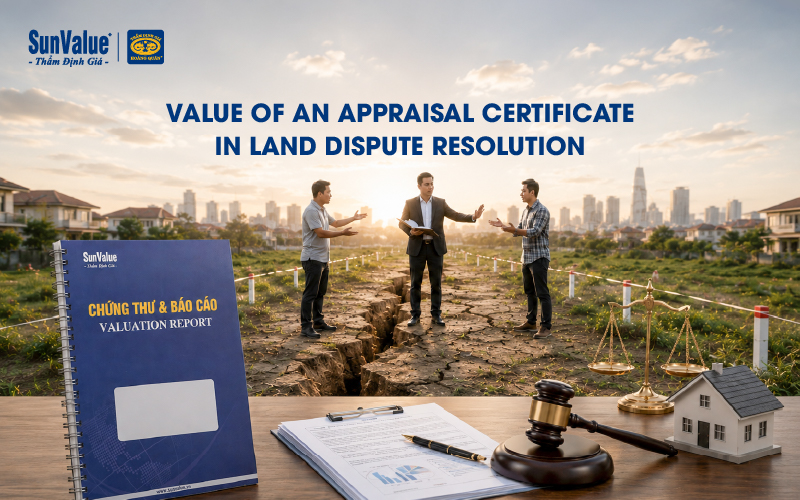
What is the value of an appraisal certificate in land dispute resolution?
Many people assume that once an appraisal certificate is available, the Court will automatically use that result to resolve the case. In reality, this is not necessarily the case.
Under procedural laws, an appraisal certificate issued by an appraisal enterprise legally qualified to operate may be submitted by the parties as one of the documents used to demonstrate asset value. However, the competent procedural authority will consider the appraisal certificate together with other evidence before making a decision.
This means that:
-
An appraisal certificate does not replace a decision of the Court or another competent authority.
-
An appraisal result does not automatically have decisive value but may serve as an important source of information for assessing asset value.
-
Selecting an appraisal enterprise with appropriate capabilities, transparent procedures and sufficient data can help improve the reliability of the appraisal result.
This is also why many individuals, enterprises and organizations choose to obtain an appraisal during the negotiation stage to establish an additional objective basis before a dispute becomes prolonged.
Mistakes that can prolong a land dispute
Many disputes continue for years not only because land laws are complex but also because the parties make mistakes from the beginning.
Common situations include:
-
Failure to retain complete legal documents: Many transactions are carried out through handwritten agreements or without registering changes, making it difficult to prove land use rights when a dispute arises.
-
Failure to clearly determine land boundaries: Long-term land use without conducting surveys or comparing the actual boundaries with cadastral records may lead to disputes over land area and boundary markers.
-
Relying only on advertised market prices: Listing prices on real estate platforms often do not fully reflect actual transaction values. If these prices are used as the basis for negotiation, it may be difficult for the parties to reach an agreement.
-
Failure to determine asset value before division: In inheritance, divorce or capital contribution disputes, dividing assets without first determining their value may lead to further disagreements even after part of the dispute has been resolved.
-
Failure to prepare sufficient evidence: Missing documents, cadastral maps, survey results or records proving the history of land use may increase verification time and affect the progress of dispute resolution.
Land appraisal services for dispute resolution at Hoang Quan Appraisal
In a land dispute, objectively determining the value of land use rights provides the parties with an additional basis for negotiation, division of assets or completion of documents as required by competent authorities. For this reason, land appraisal services play an important role in inheritance disputes, divorce, capital contributions, compensation, judgment enforcement, debt settlement or disputes involving land transfer contracts.
Hoang Quan Appraisal provides land and real estate appraisal services for dispute resolution, covering a wide range of properties including residential land, commercial and service land, production and business land, agricultural land, residential properties, construction works, factories and land-attached assets.
Key capabilities of Hoang Quan Appraisal include:
-
More than 24 years of experience in the appraisal industry.
-
300+ experts and staff members supporting appraisal assignments across various asset categories.
-
50+ offices nationwide, enabling convenient on-site surveys across multiple localities.
-
10,000+ appraisal assignments completed for individuals, enterprises, credit institutions and relevant agencies and organizations.
-
Experience in appraising various types of land and real estate for dispute resolution, litigation, judgment enforcement, debt settlement, capital contribution and transfer purposes.
-
Procedures implemented in accordance with the Law on Prices, Vietnamese Valuation Standards and applicable laws and regulations.
Each assignment at Hoang Quan Appraisal follows a structured process that includes on-site inspection, review of legal documents, collection of market data, selection of appropriate appraisal methods and preparation of the appraisal report and appraisal certificate. The appraisal result provides clients with an additional basis for determining the asset value as of the valuation date, supporting negotiations, asset division or other purposes in accordance with applicable laws and regulations.
With a commitment to independence, objectivity, transparency and information confidentiality, Hoang Quan Appraisal not only provides appraisal certificates but also assists clients in determining the appraisal scope, preparing required documents and optimizing the implementation timeline for each specific case.
Frequently asked questions
-
Is mediation mandatory for a land dispute?
Depending on the type of dispute and applicable legal regulations, certain cases must undergo mediation procedures before a lawsuit can be filed.
-
Can a land dispute be resolved if the land does not yet have a Certificate of Land Use Rights?
Yes. The resolution will be based on available records, the origin and history of land use and other supporting documents in accordance with applicable law.
-
Can the parties hire an appraisal enterprise to determine the value of land?
Yes. The parties may engage a legally qualified appraisal enterprise to determine the asset value for their intended purpose.
-
How long does a land appraisal take?
The required time depends on the type of asset, documents provided, scope of the survey and complexity of the case.
-
Does an appraisal replace the decision of the authority resolving the dispute?
No. An appraisal result is only one of the documents used for consideration and assessment in accordance with applicable law.
Conclusion
Land dispute is not only a legal matter but is also directly related to determining asset value. Preparing complete documentation, following the correct resolution procedures and determining the value of land use rights using professional methods provide the parties with an additional objective basis for protecting their lawful rights and interests. For high-value cases or matters requiring the determination of market value, appraisal is an important supporting solution that can enhance transparency and reduce risks during the dispute resolution process.


