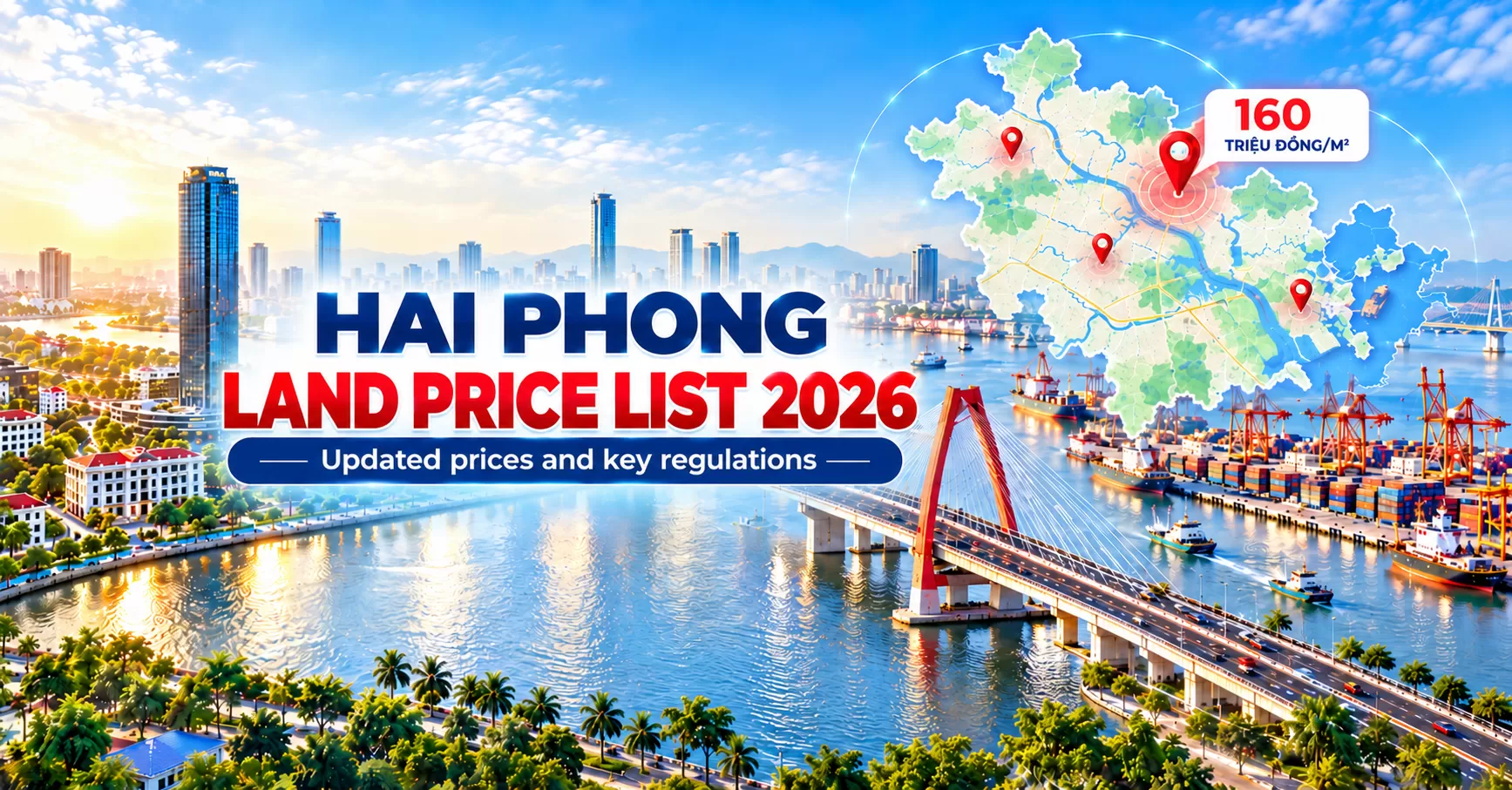
When applying for a Land Use Rights Certificate (commonly known as the "Red Book"), the factor that directly determines the amount payable is not the administrative procedure but the land price list for land title issuance issued by the Government. Effective from January 7, 2025, new land price lists have been implemented in many localities, resulting in significant changes to the cost of obtaining land titles for residential land, garden land and rural residential land. This article helps you understand the nature of the land price list, how it is applied in practice and how to accurately estimate the associated costs to avoid underpayment or overpayment during the land title issuance process.

What is the land price list for land title issuance and Why does it determine the cost?
The land price list for land title issuance is the legal basis issued by the Provincial Peoples Committee to determine the financial obligations of land users when applying for a Land Use Rights Certificate. Unlike market prices, which may be negotiated, the official land price list is mandatory and uniformly applied in administrative procedures.
During the land title issuance process, the land price list is used to calculate the registration fee (0.5%), determine land use fees in certain cases and serve as a reference during dossier appraisal. Therefore, even if the land area remains unchanged, an increase in the official land price list will result in a higher cost of obtaining the land title.
Under the 2024 Land Law, land price lists are prepared on a five-year cycle and apply for the 2025 – 2029 period. Compared to previous schedules, many localities have adjusted land prices to better reflect market values, particularly in urban areas, established residential neighborhoods and land with strong conversion potential.
An important point that land users should understand is that the land price list itself is not a fee. Instead, it serves as the basis for calculating the cost of obtaining a land title. Misunderstanding or failing to update the latest land price list may result in underpayment, requests for additional documentation or disputes regarding financial obligations.
What has changed in the 2026 land price list for land title issuance?

Starting in 2026, land price lists are being adjusted under new principles designed to more accurately reflect the actual value of land use rights. This has led many people to ask: How much does it cost to obtain a land title in 2026?
First, residential land located in areas with well-developed infrastructure, close to major transportation routes or within established residential communities has experienced significant price increases. This directly affects the cost of obtaining land titles for residential land, especially in major cities and suburban areas.
Second, although rural residential land remains less expensive than urban land, many local governments have increased official land prices to better reflect actual land use values. As a result, the cost difference between rural and urban land title issuance is no longer as substantial as before.
Third, garden land and agricultural land located within residential areas are now classified and valued more clearly. When applying for a land title or changing land use purposes, the new land price list becomes a critical basis for determining financial obligations.
In addition, from January 7, 2025, local authorities have accelerated the digitalization of land data, requiring more comprehensive surveying and verification documents. This affects not only the application process but also indirectly increases the overall cost of obtaining a land title.
How is the cost of obtaining a residential land title calculated?
For residential land, the cost of obtaining a land title depends on several factors, with the land price list for land title issuance being the primary determinant. The standard formula for calculating the registration fee is:
Registration Fee = 0.5% × (Land Area × Official Land Price)
For example, if a residential land parcel measures 80 m² and the official land price is VND 10 million per m², the value used to calculate the registration fee is VND 800 million, resulting in a registration fee of VND 4 million. This is typically the largest expense associated with land title issuance.
In addition to the registration fee, applicants are also required to pay dossier appraisal fees, surveying fees (if applicable) and the certificate issuance fee. Dossier appraisal fees vary by province, generally ranging from several hundred thousand to several million Vietnamese dong.
It is important to note that if the land type has not been accurately identified or if there are discrepancies between the actual land use and legal documentation, the competent authority will require clarification before issuing the certificate. This may extend processing time and increase the overall cost.
Cost of obtaining land titles for rural residential land and garden land in 2025
Compared with urban residential land, the cost of obtaining land titles for rural residential land is generally lower because the official land price is lower. However, this does not necessarily mean the overall cost will always be low, especially if the land documentation is incomplete or unclear.
For rural residential land with stable use history, no disputes, and compliance with planning regulations, the total land title issuance cost usually ranges from VND 1 million to VND 3 million, primarily consisting of the registration fee and administrative charges.
Meanwhile, the cost of obtaining a land title for garden land depends largely on the officially recognized land use purpose. If the garden land is recognized as residential land within the permitted quota, the applicable cost will be calculated based on the residential land price list. Otherwise, if it remains classified as agricultural land, different procedures and fee structures will apply.
Since 2025, many local authorities have required clear identification of residential land boundaries and garden land boundaries within the same parcel to prevent revenue losses. As a result, professional land valuation and accurate determination of financial obligations have become more important than ever.
First-time land title issuance costs from January 7, 2025 – What should land users know?
From January 7, 2025, the cost of obtaining a land title for the first time has been influenced by both the new land price list and stricter land administration procedures. Land users should pay close attention to three key points.
First, the updated land price list has increased the value used to calculate registration fees in many areas. Failing to update the latest land price schedule may result in inaccurate financial planning.
Second, land surveying and land origin verification procedures have become more stringent. Land parcels without cadastral maps or with changes in actual conditions may require new surveys, resulting in additional expenses.
Third, application processing times may be extended if legal documents are incomplete or inconsistent. This often leads to additional service fees or travel expenses.
Therefore, to effectively control costs, land users should prepare complete documentation, understand the applicable local land price list and consider using professional land valuation services.
Hoang Quan Appraisal – The right solution for determining the correct land price list for land title issuance and avoiding incorrect payments
As land price lists continue to change and legal regulations become increasingly stringent, accurately determining the value of land use rights has become essential for completing land title issuance in compliance with the law while controlling costs. This is why many individuals and businesses choose Hoang Quan Appraisal.
Hoang Quan Appraisal provides professional real estate valuation services for land title issuance, determination of financial obligations, land use conversion and completion of legal documentation. Our valuation certificates are prepared in accordance with professional valuation standards, possess legal validity and are widely accepted by government authorities, banks and financial institutions.
Key benefits of Hoang Quan Appraisals services
-
Determine the correct applicable land price list and avoid location-related errors.
-
Help clients avoid unnecessary payments resulting from incorrect cost calculations.
-
Standardize documentation to reduce the risk of rejection or prolonged processing.
-
Provide in-depth consultation for garden land, rural land, and land with unclear ownership history.
With extensive practical experience and a team of highly qualified valuation professionals, Hoang Quan Appraisal supports clients throughout every stage of the land title issuance process, from determining land value to completing legal documentation.
Dont let an incorrect land price list unnecessarily increase your land title issuance costs. Contact Hoang Quan Appraisal today for accurate land valuation, legally compliant consultation and efficient document preparation from the very beginning.
Hoang Quan Appraisal Co., Ltd.
Address: Hoang Quan Appraisal System
Phone: 0934.252.707
Email: contact@sunvalue.vn
Facebook: Hoang Quan Appraisal
Website: hqa.com.vn
Conclusion
The land price list for land title issuance is the key factor that directly determines the cost of obtaining land titles for residential land, garden land and rural residential land, especially following the implementation of the new regulations on January 7, 2025. Understanding the applicable land price list, calculation methods and related financial obligations enables land users to plan their finances effectively while minimizing legal risks. If you need an accurate assessment of the applicable land price list for land title issuance for your property, Hoang Quan Appraisal is ready to assist with professional, transparent and legally compliant valuation solutions.