


Real estate valuation based on planning information is a method many people use when preparing to buy, sell or invest in property. With just a few steps on a planning information portal, users can check whether a land parcel is subject to planning, determine its designated land use purpose and review future development directions for the area.
However, planning information is only one of many factors that affect real estate value. If buyers or investors rely solely on planning search results to determine a purchase or selling price, they may misjudge market value and face risks in transactions, borrowing or asset management.
In practice, to conduct real estate valuation based on planning information objectively, other factors such as legal documentation, location, current condition, transaction data and the asset’s utilization potential must also be considered. The article below highlights 5 common mistakes made by buyers, investors and businesses and provides guidance on how to assess real estate more comprehensively before making a decision.

Mistake 1: Assuming land has high value simply because it is not affected by planning
This is one of the most common assumptions in the market.
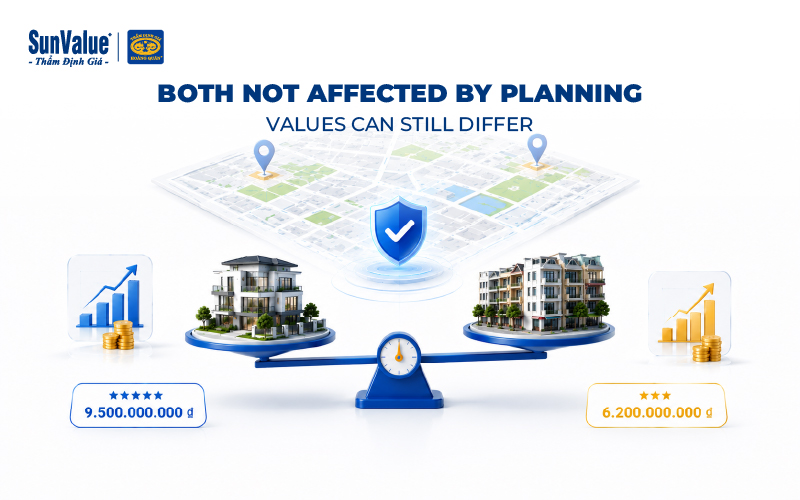
Many people believe that if a planning search shows that a land parcel is not subject to planning, they can confidently pay a higher price. However, planning information only reflects legal status and development orientation, not the actual value of the asset.
For example, two land parcels may both be outside planning areas but:
-
One is located on a major road frontage with strong business potential.
-
One is located in a narrow alley with more limited utilization potential.
Even under the same planning conditions, the market values of the two assets may still differ significantly.
When carrying out real estate valuation, planning information should be considered together with location, area, infrastructure, income-generating potential and asset liquidity.
Mistake 2: Assuming land within a planning area has no value
In contrast, many people assume that real estate affected by planning cannot be bought or sold or no longer has any value.
In practice, this is not true in every case.
The value of land affected by planning also depends on:
-
Type of planning.
-
Extent of impact on the land parcel.
-
Implementation progress of the planning.
-
Ability to continue using the land in accordance with regulations.
-
Market demand at the time of the transaction.
For example, an area planned for infrastructure development or a commercial center may create expectations of future price increases. Conversely, certain plans for public works may reduce the utilization potential of the asset.
Therefore, the value of real estate cannot be determined solely based on whether it is subject to planning.
Mistake 3: Relying only on asking prices in the market
After checking planning information, many people continue by reviewing prices listed on real estate websites to estimate the value of the asset themselves.
This is also a common mistake.
Asking prices often reflect sellers’ expectations and may not represent actual transaction prices. Meanwhile, the real estate market continuously changes by area, period and asset type.
To determine real estate value more closely in line with the market, it is also necessary to analyze:
-
Transaction prices of comparable properties.
-
Characteristics of the asset.
-
Actual utilization potential.
-
Supply and demand trends in the area.
These are among the types of data that appraisal companies usually collect and analyze before determining a valuation result.
Mistake 4: Ignoring legal documents and the actual condition of the asset
Another mistake in real estate valuation is focusing only on planning information without reviewing legal documents and the actual condition of the property.
In practice, two properties with the same area, location and planning status may still have different values if:
-
The land use rights certificate is incomplete or subject to restrictions.
-
Actual use differs from the information stated in legal documents.
-
Construction works have not been completed with required acceptance procedures or were built inconsistently with permits.
-
The asset is involved in a dispute, subject to enforcement measures or restricted from transactions.
These factors can all affect liquidity and real estate value. Therefore, asset assessment should be based on complete legal documentation combined with an actual site inspection rather than planning information alone.
Mistake 5: Failing to obtain an appraisal before a transaction
Many individuals and businesses still decide to buy, sell or accept collateral based solely on market prices or personal experience. This may lead to risks such as:
-
Purchasing real estate above market value.
-
Undervaluing the asset and causing losses to the seller.
-
Difficulty obtaining financing because the asset value does not meet the bank’s requirements.
-
Disputes arising during capital contribution or transfer transactions.
For high-value transactions, real estate appraisal not only helps determine market value but also provides a basis for negotiation and more objective decision-making.
How can real estate valuation be more accurate?
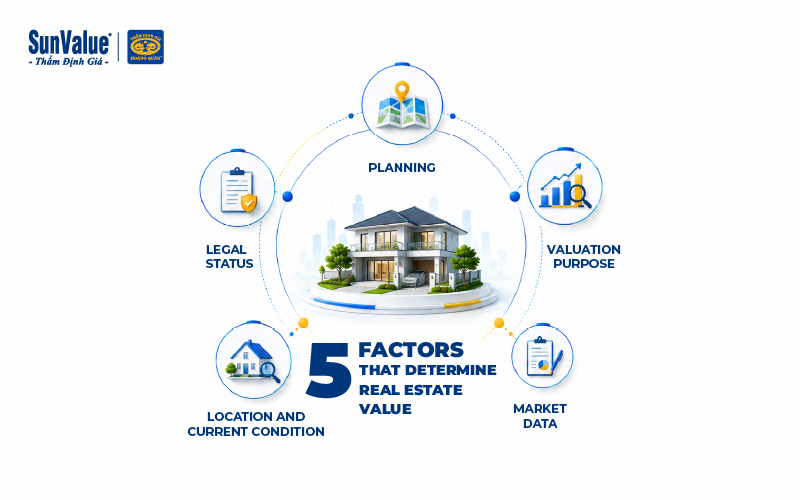
To avoid the mistakes above, valuation should follow a comprehensive assessment process rather than relying solely on planning maps.
Key factors that should be considered include:
-
Planning information: Determine how planning affects land use rights and the asset’s utilization potential.
-
Legal documentation: Review certificates, land use purposes and any legal restrictions.
-
Current condition of the property: Conduct an actual inspection of location, area, structures and infrastructure conditions.
-
Market data: Compare with transactions involving similar properties in the same area.
-
Valuation purpose: Purchase, sale, borrowing, capital contribution or collateral disposal may involve different assessment requirements.
Only by combining these factors can the market value of real estate be determined objectively.
When should real estate appraisal services be used?
Planning information helps buyers and investors understand future land use orientation but does not fully reflect the market value of real estate. In many cases, decisions based solely on planning information or market reference prices can result in inaccurate valuation, especially for high-value transactions.
This is why many individuals, businesses and credit institutions choose independent appraisal companies to obtain an additional basis before buying, selling, borrowing or handling collateral.
At Hoang Quan Appraisal, each assignment is assessed based on multiple factors such as legal documentation, location, current asset condition, the impact of planning and transaction data of comparable properties in the market. Analyzing these factors together helps determine the market value of the asset at the valuation date rather than relying on a single source of information.
The appraisal results are presented in an Appraisal Certificate and Appraisal Report and may be used for various purposes such as purchase, sale, transfer, bank borrowing, capital contribution, M&A or collateral disposal depending on the client’s needs.
If you are preparing to purchase, sell, transfer, obtain financing or contribute real estate as capital, determining the correct asset value can provide a stronger basis for negotiation and decision-making.
Hoang Quan Appraisal provides real estate appraisal services for various types of assets including houses, residential land, real estate projects and collateral. We advise clients on suitable appraisal approaches for each intended purpose and provide additional professional grounds before transactions are carried out.
Hoang Quan Appraisal Company Limited
Address: Hoang Quan Appraisal System
Phone: 0934.252.707
Email: contact@sunvalue.vn
Facebook: Hoang Quan Appraisal
Website: hqa.com.vn
Frequently Asked Questions
-
Should real estate valuation be based only on planning information?
No. Planning information only reflects land use orientation while real estate value also depends on legal status, location, current condition, transaction data and many other factors.
-
Is the asking price in the market the actual value of real estate?
Not necessarily. Asking prices often reflect sellers’ expectations. Market value should be determined by analyzing comparable transactions and the condition of the asset at the valuation date.
-
When should you hire an appraisal company?
You should consider using appraisal services when buying or selling real estate, obtaining bank financing, contributing assets as capital, handling collateral or conducting high-value transactions.
-
Is appraisal based only on planning information?
No. Appraisers assess a combination of factors such as legal documentation, current condition, location, market data and the intended use of the appraisal result.
Conclusion
Planning information is an important reference but it is not the only factor in real estate valuation. If buyers and investors rely solely on planning maps or asking prices in the market, they may make inaccurate decisions.
For high-value transactions, using professional real estate appraisal services helps determine market value based on legal documentation, the actual condition of the asset and market data, thereby reducing risks and improving transaction transparency.


