Many land parcels were issued land use rights certificates years ago without clearly specifying the residential land area, particularly parcels containing gardens or ponds or certificates that generally describe the land use purpose as residential land. This may create difficulties when transferring, inheriting or mortgaging property or completing land-related administrative procedures.
Residential land area redetermination is the process by which competent state authorities review and determine the residential land area in accordance with applicable laws for eligible cases. In 2026, this process must comply with the 2024 Land Law, Decree 49/2026/ND-CP and regulations of the locality where the land is located.

What is residential land area redetermination?
Residential land area redetermination is the process by which competent authorities review legal documents, land origin and land use history to determine the residential land area of a parcel that has already been issued a certificate but falls within a category requiring redetermination under applicable regulations.
This procedure is commonly relevant when a previously issued certificate does not specify the residential land area or records residential land together with other land categories.
For example, a land parcel has a total area of 800 m² and its old certificate records the land use purpose as “residential land + garden” without clearly distinguishing the area allocated to each land category. When a transfer or asset division is required, the land user may need to request the competent authority to review and determine the residential land area.
However, three situations must be distinguished:
|
Item |
Nature |
|
Residential land area redetermination |
Reviewing the residential land area based on legal eligibility requirements and existing documentation |
|
Change of land use purpose |
Completing procedures to convert land from one category to another |
|
Correction of a certificate |
Rectifying incorrect information on a certificate in accordance with regulations |
Redetermination does not mean that the entire land parcel will be recognized as residential land. The result depends on the supporting documents, land use origin and applicable regulations.
Eligibility requirements for residential land area redetermination in 2026
Under Clause 6, Article 141 of the 2024 Land Law, residential land area redetermination for certain land parcels issued before July 1, 2004 must satisfy specific conditions.
In its guidance dated July 21, 2026, the Ministry of Agriculture and Environment identified four conditions to be considered.
1. The parcel was previously classified as residential land with gardens or ponds or as residential homestead land
The land parcel must fall within the category of residential land with gardens or ponds or residential homestead land based on previous land records and land management and use history.
For parcels with houses constructed many years ago but certificates recording multiple land categories, competent authorities must cross-check the relevant information to determine the applicable case.
2. The certificate was issued before July 1, 2004
This is an important date when considering the application of Clause 6, Article 141 of the 2024 Land Law.
Land users should verify the date on which the certificate was first issued and review any subsequent certificate replacements, corrections or registrations of land-related changes.
The issuance date of the current certificate alone should not be used to determine whether a land parcel is eligible.
3. The required land use rights documents are available
Before the certificate was issued, the land parcel must have had at least one of the documents specified in Clauses 1, 2, 3, 5, 6 and 7 of Article 137 of the 2024 Land Law.
Depending on the case, the documentation may include land use rights records established during different periods, land registration documents or other lawful documents covered by the relevant provisions.
These documents provide the basis for competent authorities to review the lands origin and residential land area.
4. The conditions concerning transfers of land use rights are satisfied
For land areas where land use rights have been transferred in accordance with regulations or where land has been recovered by the State, the law imposes limitations on residential land area redetermination.
Therefore, parcels that have undergone sale and purchase, division or changes in land use rights must be examined individually rather than relying solely on the certificate previously held by an earlier land user.

Note: The four conditions above provide the basis for consideration under Clause 6, Article 141. Cases not covered by this clause but involving old certificates that do not specify the residential land area may be considered under another mechanism provided in Decree 49/2026/ND-CP.
Cases that may qualify for residential land area redetermination
Certificates issued before 2004 without a clearly specified residential land area
Some older certificates record a general land use purpose without separately identifying residential land and other land areas.
Under Clause 2, Article 20 of Decree 49/2026/ND-CP, where a certificate was issued before July 1, 2004 and the case does not fall under Clause 6, Article 141 of the Land Law but the residential land area has not been specifically determined, the determination may be carried out in accordance with regulations issued by the provincial-level Peoples Committee.
Descriptions appearing on certificates may include:
-
Residential homestead land, concentrated residential land or land for house construction.
-
Residential land + garden.
-
Codes T, TV, TQ and TTT.
The presence of these descriptions or codes does not automatically mean that the entire land parcel is residential land.
Land with a long history of use
For land originating from use before 1980 or during other historical periods, land registration records and documents establishing land use rights may play an important role.
However, the date when land use began is not the sole basis for determining the area eligible for recognition.
Land users should review the date of the parcels formation, legal documentation and regulations applicable at the time of assessment.
Land with a replaced land use rights certificate
Where an old certificate was replaced after July 1, 2004, the case should be reviewed based on the certificate issuance history and the recorded residential land area.
In particular, Clause 2, Article 20 of Decree 49/2026/ND-CP provides regulations for certain cases involving old certificates that did not specifically identify residential land areas, including cases where changes occurred after that date.
Conversely, if the transferee has been issued a new certificate that already specifies the residential land area, the case does not fall within the scope of redetermination under this clause.
Subdivided or inherited land
For subdivided land, redetermination requires reviewing the original parcels documentation, subdivision history and legal status of each existing parcel.
In inheritance cases, land users may be eligible to complete inheritance procedures and residential land area redetermination simultaneously if the legal requirements are satisfied.
These situations must be resolved based on archived records and local regulations.
What documents are required for residential land area redetermination in 2026?
The documentation for residential land area redetermination provides the basis for competent authorities to verify the lands origin, land use history and information recorded on the land use rights certificate.
Under Clause 1, Article 15 of Decree 49/2026/ND-CP, provincial-level Peoples Committees are authorized to prescribe land-related administrative procedures. Therefore, the required documents must comply with the procedures officially published in the locality where the land is located.
Land users should check and prepare the relevant documents:
-
The issued land use rights certificate and previous certificates, if available.
-
Documents proving the lands origin and the period of land use.
-
Cadastral documents, maps or land registration records from different periods.
-
Transfer, inheritance, donation, subdivision or certificate replacement documents, if applicable.
-
An application and additional documents required under the locally published administrative procedures.
The documents listed above are for reference and do not represent a uniform set of mandatory requirements for every case.
For parcels with complex legal documentation, land users should contact the competent authority for guidance before submitting an application.
How is residential land area redetermination carried out?
Residential land area redetermination procedures in 2026 are conducted in accordance with the 2024 Land Law, Decree 49/2026/ND-CP and applicable local regulations.
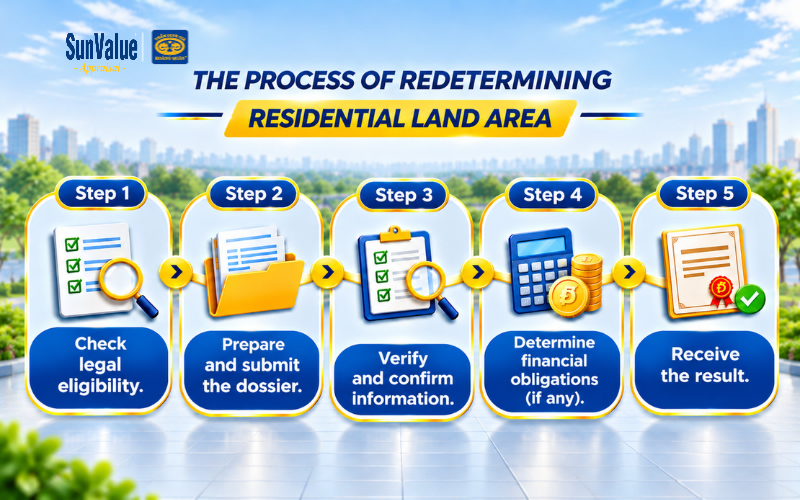
In principle, the process generally consists of the following five basic steps:
-
Step 1 – Verify legal eligibility: Review the certificate, initial issuance date, land use origin and subsequent changes to identify the applicable legal provisions.
-
Step 2 – Prepare and submit the application: The land user prepares the required documents according to locally published administrative procedures and submits them to the competent receiving authority.
-
Step 3 – Review and verify information: The competent authority examines the application, cross-checks cadastral data and determines the residential land area in accordance with regulations. Additional documents may be requested where necessary.
-
Step 4 – Determine financial obligations, if any: Financial obligations are determined according to the specific case and notifications issued by the competent authority.
-
Step 5 – Receive the result: After completing the procedures and fulfilling the relevant obligations, the land user receives the official result in accordance with regulations.
For certain cases covered by Clause 2, Article 20 of Decree 49/2026/ND-CP, residential land area determination is carried out simultaneously with the registration of land-related changes. If the land user requests a separate procedure, the sequence and procedures are prescribed by the provincial-level Peoples Committee.
How long does residential land area redetermination take?
The processing time for residential land area redetermination should not be understood as a fixed period applicable to every application nationwide.
According to publicly available administrative procedure information from certain localities in 2026:
-
Lao Cai: A processing period of 20 working days is published for residential land area redetermination procedures within the prescribed scope.
-
Cao Bang: A processing period of no more than 18 working days is published, extending to no more than 28 working days in certain special areas.
-
Vinh Long: A processing period of no more than 20 working days is published for a procedure involving residential land area redetermination, extending to no more than 30 working days in certain areas.
These processing periods are provided for comparison only and do not replace the regulations applicable in the locality where the land is located.
The actual processing time also depends on the condition of the application, verification of the lands origin and periods excluded from the statutory processing time.
Land users should consult the administrative procedures currently in force in their locality to determine the applicable processing period.
Are there fees for residential land area redetermination?
The costs involved depend on the type of procedure, locality and financial obligations arising in each specific case.
The following cost categories should be distinguished:
-
Administrative fees and charges: Applied in accordance with local regulations and officially published procedures.
-
Surveying and technical documentation costs: May arise when additional professional work is required.
-
Land-related financial obligations: Determined according to applicable laws and the specific legal status of the land parcel.
Some localities publish procedures that do not require administrative fees or charges, while procedures involving certificate issuance may incur corresponding fees.
Therefore, it cannot be assumed that residential land area redetermination is free of charge in every case or that all applicants must pay the same amount.
Before proceeding, land users should check the information published on the National Public Service Portal or the official portal of the locality where the land is located.
Does residential land area redetermination affect real estate value?
The legally recognized residential land area is one of the legal factors that may affect the value of land use rights.
For properties with the same location and total land area, differences in the proportions of residential land and land designated for other purposes may lead to differences in utilization potential, permitted uses and market value.
For example, consider two land parcels, each measuring 600 m²:
|
Criteria |
Land Parcel A |
Land Parcel B |
|
Total land area |
600 m² |
600 m² |
|
Residential land area |
150 m² |
300 m² |
|
Other land area |
450 m² |
300 m² |
|
Impact on value |
Must be assessed based on the land use composition |
May differ due to the higher proportion of residential land |
This hypothetical example illustrates the potential impact of land use composition and does not represent an actual appraisal result.
However, a larger residential land area does not necessarily mean that the propertys value will increase by the same proportion.
The result also depends on location, planning, accessibility, legal conditions, land use term and market information at the appraisal date.
In particular, when an application for residential land area redetermination is being processed, it is necessary to distinguish between the area already recognized by the competent authority and the area newly proposed for consideration. An area expected to be recognized should not be treated as a legally finalized result.
When is land use rights appraisal necessary?
Is the residential land area unclear, have the legal documents undergone changes or are you preparing for a real estate transaction? Establishing an appropriate land use rights value provides an important basis for reducing risks and making financial decisions.
Land use rights appraisal is particularly necessary in the following cases:
-
Sale, purchase and transfer: Provides a reference basis for property value to support negotiations and transactions.
-
Bank financing: Determines the value of collateral for lending purposes.
-
Capital contribution and asset division: Provides a basis for determining land use rights value for the parties involved.
-
Asset management: Supports businesses in assessing asset value, financial planning and investment.
-
Complex land documentation: Assesses property value based on legal status, recognized residential land area and land use purpose.
With more than 24 years of experience in the appraisal industry, Hoang Quan Appraisal provides real estate and land use rights appraisal services for individuals, businesses and credit institutions, helping clients obtain an objective basis for assessing asset value and making informed decisions.
Do not let uncertainties surrounding asset value disrupt your transaction and financial plans.
Contact Hoang Quan Appraisal for consultation on documentation requirements, service scope and an appraisal quotation tailored to your needs.
Explore our services:

Frequently asked questions about residential land area redetermination
- Can the residential land area be redetermined if the certificate was issued before 2004?
The case may be considered if the legal requirements are satisfied. However, the fact that a certificate was issued before July 1, 2004 is not sufficient on its own to establish eligibility for residential land area redetermination.
- Does a land use rights certificate marked with the letter T mean that the entire parcel is recognized as residential land?
Not automatically. The certificate, cadastral records and local regulations must be reviewed to determine the appropriate residential land area.
- Can residential land area be redetermined for a subdivided land parcel?
The original land parcels documentation, subdivision history, previous determination of residential land area and relevant legal requirements must be reviewed.
- Can residential land area redetermination be requested if the certificate already specifies the residential land area?
Not every case is eligible for redetermination. If the area has already been correctly determined in accordance with the law, an additional area cannot automatically be requested for recognition. If a certificate is found to have been issued contrary to regulations, the appropriate corrective procedures must be followed.
- Can residential land areas be redetermined during inheritance procedures?
Yes, provided that the applicable requirements are satisfied. In certain cases, inheritance procedures and residential land area redetermination may be completed simultaneously in accordance with regulations.
Conclusion
Residential land area redetermination in 2026 must be considered based on the certificate issuance date, land origin, legal documentation and history of changes in land use rights. Clause 6, Article 141 of the 2024 Land Law and Clause 2, Article 20 of Decree 49/2026/ND-CP are two important legal bases for cases involving older certificates.
Land users should thoroughly review their documentation and contact the competent local authority before initiating the procedure. When it is necessary to determine land use rights value for transactions, financing or asset management, professional appraisal services may provide an additional basis for informed decision-making.